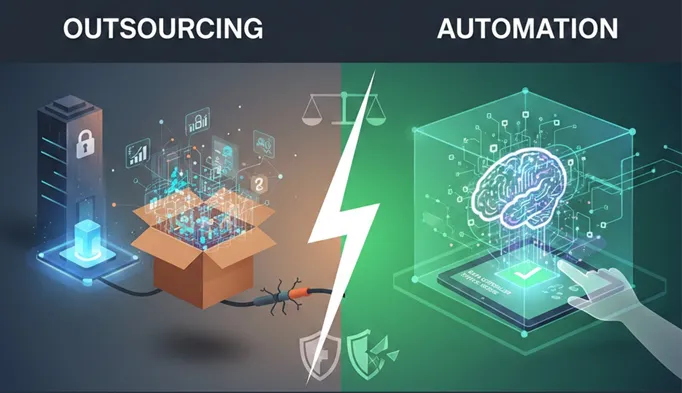
Automation vs. Outsourcing: Which DSAR Strategy Protects Your "Data Controller" Status?
As the volume and complexity of Data Subject Access Requests (DSARs) continue to surge across the UK, Data Protection Officers (DPOs) are hitting a critical capacity ceiling. When the internal legal or compliance team can no longer manually review and redact thousands of emails, PDFs, and CCTV frames within the statutory 30-day window, a strategic pivot becomes necessary.
For most organisations, the choice comes down to two paths: outsourcing the redaction process to an external forensic or legal firm, or investing in automated redaction software to keep the process in-house.
While both options solve the immediate capacity problem, they carry vastly different implications for your organisation's risk profile and legal standing under the UK GDPR. Specifically, one strategy heavily dilutes your control, while the other actively protects your status—and liability—as the ultimate Data Controller.
The Hidden Liability of Outsourced Redaction
When a privacy team is overwhelmed by a sprawling DSAR, boxing up gigabytes of unstructured data and sending it to a third-party legal or forensic vendor seems like an attractive lifeline. However, this approach introduces significant off-site security risks and complex compliance hurdles.
Under the UK GDPR, when you hand over personal data to a third party for redaction, you are engaging a Data Processor. As the Data Controller, you remain ultimately accountable to the Information Commissioner's Office (ICO) for how that data is handled.
Outsourcing creates a sprawling attack surface. You are transmitting highly sensitive, unredacted corporate data—which often includes third-party personally identifiable information (PII), confidential HR grievances, and proprietary business communications—outside your secure corporate perimeter. Even with robust Data Processing Agreements (DPAs) (as required under Article 28) and strict vendor risk assessments, you are essentially trusting a third party's IT infrastructure to be as resilient as your own. If that vendor suffers a data breach, it is your organisation's reputation on the line, and the ICO will look directly at you for answers.
Furthermore, outsourced redaction is prohibitively expensive and inherently slow. It scales linearly; the more data you have, the more billable hours the vendor charges, making it an unsustainable long-term strategy for managing the rising tide of DSARs.
Retaining Control: The In-House Automation Model
The alternative is to empower your existing internal team with automated redaction technology. By integrating AI-driven computer vision and natural language processing into your own workflows, you drastically reduce processing time without relinquishing custody of the raw data to an external human workforce.
Automated redaction flips the operational model. Instead of a team of external paralegals spending weeks reading through email threads or tracking faces frame-by-frame in CCTV footage, the software performs the heavy lifting in minutes. The AI instantly identifies PII, applies custom regex patterns to spot specific terms, and securely blurs faces in surveillance media.
Crucially, this model protects your Data Controller status. The AI does not make the final, legally binding decisions; it acts as a high-speed assistant. Your internal privacy professionals review the automated output, applying necessary legal privilege exemptions and confirming the final redactions. This "human-in-the-loop" approach ensures that your organisation retains absolute authority over what is—and isn't—disclosed.
The "Duty of Care" and Zero-Retention Architecture
If you choose to bring automation in-house, the security architecture of the software you select is paramount. Legacy document management platforms often struggle to process unstructured media securely, and basic PDF editors are notorious for "false redactions" that leave hidden metadata and text layers exposed to the recipient.
To truly protect your liability, you must deploy a tool built specifically for secure, irreversible data destruction.
A legally defensible redaction platform must feature a strict "zero-retention" architecture. This means the software processes the data but does not store it indefinitely. For example, platforms that utilise an automated 24-hour server-side deletion script ensure that your sensitive DSAR data never accumulates in a third-party cloud environment, eliminating the risk of a secondary data breach. Combined with AES-256 encryption at rest and HTTPS/TLS 1.2+ encryption in transit, this architecture provides a secure enclave for processing that outsourced human review simply cannot match.
By keeping the process in-house and relying on secure AI to accelerate the workflow, you satisfy the ICO's statutory deadlines, protect your budget, and maintain ironclad control over your organisation's most sensitive data.
Stop sending your most sensitive corporate data off-site. See how you can accelerate your in-house DSAR processing and protect your Data Controller status by starting a free trial of Acuity AutoRedact today.